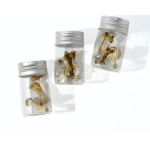
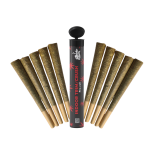
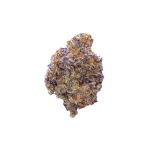
Strain names are the first thing you see on most cannabis menus — Cherry Whip, Durban Poison, Wedding Cake, Purple Mimosa. They are also one of the least reliable guides to what is actually in the jar.
That doesn’t make them useless. A name can hint at a style of flower, a family of aromas, even a lineage. But it is not a guarantee of genetics, THC content or how a particular batch will turn out. This guide explains what a cannabis strain is, why the same name can mean noticeably different flower from one batch or seller to the next, and what to look at instead when you’re comparing.
The short version: a strain is a named variety of cannabis. The name is a starting point for aroma and style, not a promise. Grade, how the plant was grown, how it smells and — where it exists — lab data for the specific batch tell you more than the name does.
For adults aged 18 and over. This guide is general information, not medical advice.
What is a cannabis strain?
“Strain” is the everyday word for a named variety of cannabis. Growers usually say cultivar (a cultivated variety), and researchers have proposed grouping plants into chemovars — groups defined by their measured chemical makeup rather than by what someone decided to call them1.
That distinction matters because a strain name is a label, not a measurement. Researchers studying the United States market noted that more than 2,000 named strains are sold to consumers there, and that cannabis varieties are excluded from the formal variety registration other crops go through2. A name on its own is not evidence of what the plant is.
Names tend to come from a few places:
- Parentage — a new variety named after, or combining, the names of the plants it was bred from.
- Aroma or flavour — names like Cherry Whip, Mandarin Cookies or Triple Cheese point to what the breeder wanted you to notice first.
- Place — Durban Poison, named after the South African city, is a familiar example.
- Marketing — some names are simply memorable and say nothing about the plant.
Why the same strain name can mean different plants
Seeds, cuttings and phenotypes
Cannabis can be grown from seed or from cuttings (clones). A cutting is genetically identical to the plant it was taken from. Seeds are not: plants grown from the same seed batch are siblings, and like siblings they can differ in height, bud structure, aroma and chemistry. Each distinct expression of a variety’s genetics is called a phenotype.
So two growers can both sell “the same” strain and be growing different phenotypes of it — or a different plant that has picked up the name along the way. Genetic studies bear this out: strain names often do not reflect a meaningful genetic identity3, and samples sold under the same name are not always closely related2.
One study tested 122 samples of 30 commercial strains, sourced from dispensaries and donors in three US states2. Two strains both sold as mostly sativa — Durban Poison (labelled 100% sativa) and Sour Diesel (labelled 90% sativa) — fell largely into different genetic groups. And while most of the Durban Poison samples were genetically consistent with each other, some pairs of samples sold as Sour Diesel showed little or no genetic relationship at all2.
The same genetics, grown differently
Even when the genetics really are identical, the result is not fixed. In one study of two commercial cultivars, genetically identical plants grown indoors (under artificial light, in artificial growing media) and outdoors (in living soil, under sunlight) showed significantly different cannabinoid and terpene profiles7.
It helps to think in three layers:
| Layer | What it is | What changes it | What you can actually check |
|---|---|---|---|
| Genetics | The variety the name is supposed to point to | Breeding; whether plants came from a cutting or from seed | Usually very little — lineage claims are hard to verify |
| Phenotype | Which expression of those genetics was selected | The grower’s selection of plants | Aroma, bud structure, appearance |
| This batch | The flower from this harvest | Growing conditions, harvest, drying, curing and storage | Grade, cultivation method, aroma, lab data where available |
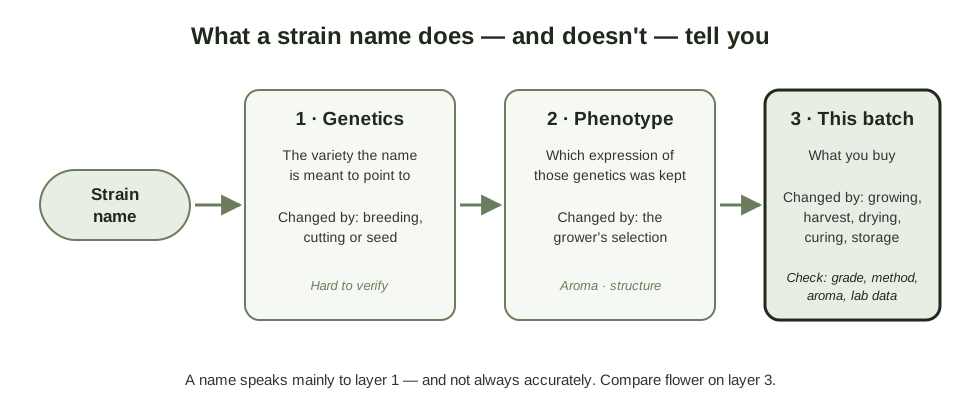
A strain name only speaks to the first layer — and, as the research shows, not always accurately. What you buy is the third.
Indica, sativa and hybrid: what the labels mean on a menu
Many menus sort strains into indica, sativa and hybrid, and many sellers use those words as shorthand for an effect: indica for relaxing, sativa for energising, hybrid somewhere in between.
The research doesn’t support relying on them that way. A study of more than 100 samples found that plants labelled sativa and plants labelled indica were not genetically distinct across their genomes; the labels were associated with differences in only a small number of terpenes4. A far larger analysis of commercial flower from six US states found that indica, sativa and hybrid labels did not consistently match the plants’ measured chemistry, even if some labels leaned towards certain chemical profiles5. One prominent cannabinoid researcher has argued that the terms should be dropped altogether in favour of measuring each plant’s chemical profile9.
That is why our Flowers page doesn’t attach indica or sativa effect claims to a batch. You may still see the words on product listings, as a rough family description. Treat them that way, not as a prediction of how a product will feel.
THC, potency and why “strongest strain” lists mislead
Search for the strongest weed strains and you’ll find ranked lists quoting eye-catching THC percentages. Those figures are lab results for particular batches, often from other markets. They don’t travel with the name.
Three reasons to read any THC figure carefully:
- Growing conditions change chemistry. The same genetics grown in different conditions can produce a measurably different cannabinoid and terpene profile7.
- Labs differ. An analysis of one US state’s legal-market testing data found that different laboratories reported systematically different cannabinoid levels, and those differences persisted after accounting for other explanations6.
- THC isn’t the whole picture. Plants also differ in their other cannabinoids and in their terpenes5.
A higher number is not automatically a better choice. Evidence-based public-health guidelines on lower-risk cannabis use recommend choosing low-potency THC products, or products with a balanced THC-to-CBD ratio10.
When the potency figure isn’t about the strain
Some products carry a strain name and a very high THC figure. Our infused pre-rolls are an example: budder-infused joints (flower with budder) and triple-infused Moonsticks (flower, kief and distillate) are listed at 38–50% THC. Those figures come from combining flower with concentrates. The number describes the finished product, not the strain named on it.
Terpenes and aroma: the most practical clue you have
Terpenes are among the hundreds of compounds in cannabis resin, alongside cannabinoids8. Many terpenes are strongly aromatic, and they’re a big part of why Mandarin Cookies smells nothing like Triple Cheese.
A few with well-documented aromas:
Across nearly 90,000 lab-tested samples of US commercial flower, most THC-dominant cannabis fell into three broad terpene groups: high in caryophyllene and limonene; high in myrcene and pinene; or high in terpinolene and myrcene5.
Two cautions. First, claims about the medicinal properties of cannabis compounds, terpenes included, still need thorough scientific validation, so we don’t make them8. Second, terpenes are volatile, so aroma can fade as flower ages or if it is stored badly. A strain that should smell of citrus but doesn’t is telling you something about that batch.
For choosing flower, aroma is useful precisely because it belongs to the batch in front of you, not to the name on the label.
How to compare strains when you’re buying flower
A name is where you start, not where you decide. When you’re comparing flower, work through what actually describes the batch:
- Grade. Our grades describe the flower itself — bud structure, finish and curing — which a name can’t. The grading guide on our Flowers page explains the difference between AA and AAA.
- How it was grown. Greenhouse, organic indoor and veganic living-soil flower are grown in different conditions, and growing conditions measurably affect a plant’s chemistry7. The method is worth knowing.
- Aroma. Look for what the flower smells like and whether that matches what you enjoy.
- Lab data, where it exists. Results for a specific batch tell you more about its cannabinoid content than a strain name can — though, as above, results can differ between laboratories6.
- Try small, then buy more. Our single-gram listings let you choose flower or a pre-roll at the same price, so you can try a strain before committing. If it suits you, you can buy in bulk later.
- Keep notes. Write down the strain, grade, when you bought it and how you found it. Over a few purchases, that record is worth more than any strain review.
- Ask. Our range rotates with each harvest. If you want to know what the current batch of a strain is like, message us and we’ll tell you.
Researching a strain name you’ve seen
If a name on a menu catches your eye — ours or anyone else’s — a quick search will turn up strain database pages listing lineage, aroma notes, THC ranges and effects. Use them carefully:
- Useful: reported parentage and aroma descriptions, as a rough guide to style.
- Treat with caution: fixed splits such as “80% sativa / 20% indica” and THC ranges. They describe other growers’ plants, not the batch in front of you.
- Ignore: lists of medical conditions a strain is “suggested to treat”. A strain name is not evidence of that, and no retailer’s listing should be read as medical advice.
- Check more than one source, and remember that plants sold under the same name are not always closely related2.
Frequently asked questions
Is a strain the same as a brand?
No. A strain is a variety of plant; a brand is a business that grows, packages or sells it. Two brands can sell the same strain name and grow quite different flower.
Does the same strain always have the same THC level?
No. Plants sold under one name can differ genetically2, growing conditions change a plant’s chemistry7, and laboratories can report cannabinoid levels differently6. Treat any THC range attached to a strain name as approximate.
Are indica strains relaxing and sativa strains energising?
That is how the labels are commonly used, but research has found that indica and sativa labels are poor guides to a plant’s genetics and chemistry4, 5.
What is the strongest weed strain?
There isn’t a reliable answer. “Strongest strain” lists quote lab results for particular batches; the same name grown elsewhere can test very differently. Potency belongs to a batch, not to a name.
What’s the difference between a strain and a phenotype?
The strain is the named variety. A phenotype is one specific expression of that variety’s genetics — seed-grown plants of the same strain can produce several distinct phenotypes.
Why does the same strain smell different from different sellers?
It may be a different phenotype, a different plant using the same name, or the same genetics grown in different conditions7. Aroma can also fade as flower ages.
Can a strain name tell me whether cannabis is suitable for a health condition?
No. Strain names and product descriptions are not medical information. If you have a health condition or take medication, speak to a healthcare professional.
The takeaway
Strain names are part of the culture and part of the fun, and they can point you towards styles and aromas you like. Just don’t treat them as a guarantee. Grade, how it was grown, how it smells and what lab data says about the batch will serve you better than any name on the jar.
When you’re ready, see what’s in the range, or check our delivery and collection questions.
Cannabis is for adults aged 18 and over. Consume responsibly and privately. Do not drive after use.
About this guide: Written by the AmazolSA team. The research findings in this guide are referenced below. Last reviewed: 14 September 2026. Next review: 14 September 2027.
Sources
- Hazekamp A, Fischedick JT. Cannabis – from cultivar to chemovar. Drug Testing and Analysis. 2012;4(7–8):660–667. doi:10.1002/dta.407
- Schwabe AL, McGlaughlin ME. Genetic tools weed out misconceptions of strain reliability in Cannabis sativa: implications for a budding industry. Journal of Cannabis Research. 2019;1(1):3. doi:10.1186/s42238-019-0001-1
- Sawler J, Stout JM, Gardner KM, et al. The genetic structure of marijuana and hemp. PLOS ONE. 2015;10(8):e0133292. doi:10.1371/journal.pone.0133292
- Watts S, McElroy M, Migicovsky Z, et al. Cannabis labelling is associated with genetic variation in terpene synthase genes. Nature Plants. 2021;7(10):1330–1334. doi:10.1038/s41477-021-01003-y
- Smith CJ, Vergara D, Keegan B, Jikomes N. The phytochemical diversity of commercial Cannabis in the United States. PLOS ONE. 2022;17(5):e0267498. doi:10.1371/journal.pone.0267498
- Jikomes N, Zoorob M. The cannabinoid content of legal cannabis in Washington State varies systematically across testing facilities and popular consumer products. Scientific Reports. 2018;8:4519. doi:10.1038/s41598-018-22755-2
- Zandkarimi F, Decatur J, Casali J, et al. Comparison of the cannabinoid and terpene profiles in commercial cannabis from natural and artificial cultivation. Molecules. 2023;28(2):833. doi:10.3390/molecules28020833
- Booth JK, Bohlmann J. Terpenes in Cannabis sativa – from plant genome to humans. Plant Science. 2019;284:67–72. doi:10.1016/j.plantsci.2019.03.022
- Piomelli D, Russo EB. The Cannabis sativa versus Cannabis indica debate: an interview with Ethan Russo, MD. Cannabis and Cannabinoid Research. 2016;1(1):44–46. doi:10.1089/can.2015.29003.ebr
- Fischer B, Russell C, Sabioni P, et al. Lower-Risk Cannabis Use Guidelines: a comprehensive update of evidence and recommendations. American Journal of Public Health. 2017;107(8):e1–e12. doi:10.2105/AJPH.2017.303818
- PubChem, US National Library of Medicine — compound records for limonene (CID 22311), α-pinene (CID 6654) and linalool (CID 6549), “Odor” sections. Accessed 14 September 2026.